EV Charging
- Diversified peak-period EV charging load
- Charging times and diversity
- EV travel and charging requirements
- EV adoption and future penetration
Stress test managed-charging strategies against changing EV loads, participation, costs, technology and weather conditions.
One-size-fits-all static managed-charging programs can be costly.
Growing residential EV ownership increases utility sales and revenue. But those benefits can be overwhelmed by higher peak-demand costs and localized transformer and feeder upgrades.
Managed charging can control these costs. But what kind of program is needed, how much participation is enough, and will today's program still work as EV ownership grows?
Treating managed charging as a risk-management problem rather than simply a rate or program-design decision helps answer these questions.
The Grid Impact Model risk-management framework builds on decades of Jackson Associates energy risk analysis. While a professor at Texas A&M University, GIM developer Dr. Jerry Jackson authored the 2008 Wiley Finance book Energy Budgets at Risk (EBaR)®: A Risk Management Approach to Energy Purchase and Efficiency Choices. The book developed a structured framework for applying financial risk-management concepts to energy costs, energy-efficiency investments and energy decision-making.
GIM extends this risk-management perspective to a new utility challenge: managing the financial and local-grid risks associated with growing residential EV ownership.
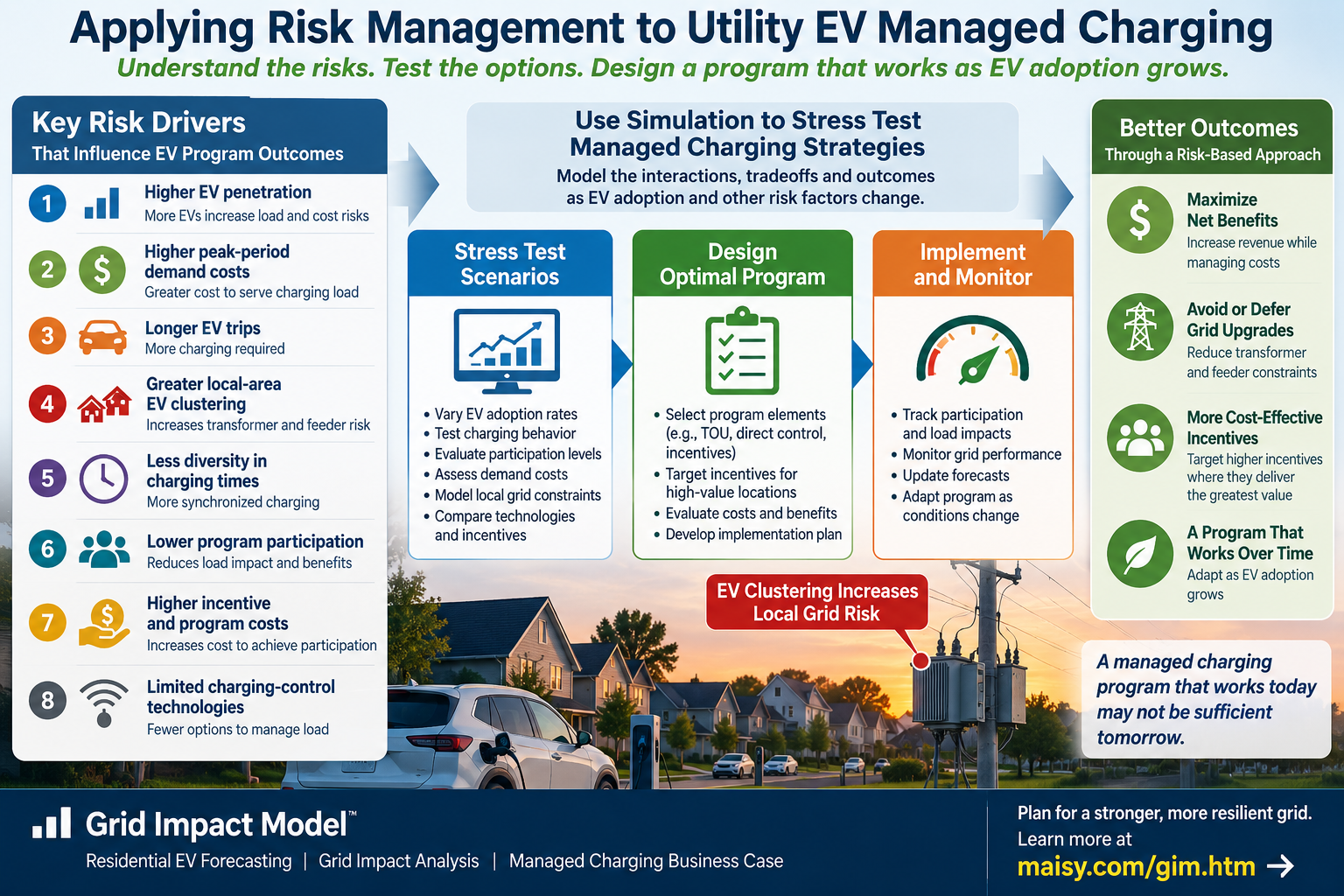
The risk of negative EV financial and grid outcomes can increase with:
TOU rates are the most common approach for encouraging off-peak EV charging. But as EV penetration increases, so do the potential consequences of peak demand, EV clustering and synchronized charging.
A program that works today may not be sufficient as EV ownership grows.
A risk-management approach addresses this problem by:
The objective isn't simply to manage EV charging today. It is to develop a strategy that continues to work as EV ownership grows.
The Grid Impact Model allows the utility or its consultant to establish a baseline managed-charging scenario reflecting its own assumptions about EV charging and program design.
GIM calculates the resulting hourly loads, peak-demand impacts, localized grid effects, program costs and utility financial outcomes.
The same analysis can then be rerun with one or several assumptions changed.
A utility might begin with its expected assumptions for EV peak load, managed-charging participation, program costs, technology costs and weather.
It can then ask:
What if EV peak loads are higher than expected?
What if only 15% of EV owners participate instead of 30%?
What if customer incentives have to be increased to obtain the required participation?
What if technology or program administration costs are higher?
What if extreme weather increases coincident residential and EV loads?
What if EV ownership becomes highly concentrated behind particular transformers or feeder laterals?
Each assumption can be changed independently or combined with others to create expected, adverse and favorable scenarios.
This makes it possible to determine not only whether a managed-charging strategy works under baseline assumptions, but how robust the strategy remains when those assumptions change.
Scenario analysis can also identify the point at which a program achieves—or fails to achieve—a utility's financial or grid objective.
These threshold analyses convert uncertainty into specific program requirements and decision points.
Rather than simply asking whether a program is expected to work, the utility can ask:
For example:
Grid Impact Model risk analysis is designed around transparent, user-defined assumptions.
The utility or consultant determines the assumptions to be tested. GIM carries those assumptions through the customer-level load, grid-impact and financial calculations to produce the resulting outcomes.
The process is straightforward:
This makes it possible to see what changed, why the result changed and which assumptions matter most.
The analyst can vary a single assumption to measure its impact or change several assumptions simultaneously to construct a more demanding stress scenario.
GIM does not replace the analyst's judgment—it provides a structured way to test it.
The risk-management approach incorporated in GIM builds on concepts developed by Dr. Jerry Jackson in Energy Budgets at Risk (EBaR)®: A Risk Management Approach to Energy Purchase and Efficiency Choices, published by John Wiley & Sons in 2008 while Dr. Jackson was a professor at Texas A&M University.
EBaR applied risk-management concepts developed in the financial industry to energy purchasing, energy costs and efficiency-investment decisions. Its central management perspective was that energy decisions should consider not only an expected economic outcome, but also the uncertainty surrounding the assumptions that determine that outcome.
The Grid Impact Model applies that same management perspective to residential EV planning.
EV adoption, charging behavior, peak loads, customer participation, program costs, technology costs, weather and local grid conditions are all uncertain. Rather than relying on a single set of assumptions, GIM allows utilities and their consultants to change those assumptions, stress test the resulting managed-charging strategy and determine how sensitive financial and grid outcomes are to each risk factor.
The application has changed—from facility energy purchasing and efficiency investment to utility EV managed charging—but the underlying management question remains similar:
Systemwide averages can conceal important local differences.
EV ownership is not distributed uniformly. Local concentrations of EVs can produce substantially greater charging loads in some neighborhoods than suggested by utility-wide EV penetration.
That can be particularly important where transformers or feeder laterals are already approaching planning limits.
Consider two otherwise identical managed-charging participants:
GIM's customer-level and geographic analysis makes it possible to combine the utility-wide managed-charging business case with localized grid risk to evaluate strategies such as targeted monitoring, geographically targeted participation and differentiated program incentives.
GIM provides utility planners and managers with a way to evaluate managed charging before committing to a particular program design—and to reevaluate that strategy as EV ownership grows.
Utilities can use the risk-management analysis to:
For co-ops, GIM can explicitly incorporate G&T energy and demand rates into the managed-charging business case. The same analytical framework can be applied to municipal utilities and IOUs using their applicable energy, capacity and demand-cost structures.
The result is not a static managed-charging recommendation. It is a repeatable planning process that can evolve with EV ownership, utility costs and grid conditions.
GIM can serve as an upstream analytical resource for engineering and management consulting engagements.
The consultant retains control over the assumptions and can use GIM to evaluate the questions most important to a particular utility client.
A consulting team can show its client:
This provides a transparent analytical foundation that can support:
GIM can also provide customer-level 8,760 hourly load profiles and geographic results that help direct more detailed distribution-system modeling toward areas with the greatest potential constraints.
The objective is to complement—not replace—the consultant's engineering and management expertise.
The consultant supplies the judgment. GIM provides a structured, utility-specific environment for testing that judgment.
EV adoption, charging behavior, technology costs, customer participation and grid conditions will change.
A managed-charging strategy therefore should not be evaluated only once.
The same GIM analysis can be updated periodically to compare actual conditions with earlier assumptions, identify emerging risks and determine whether changes in program design, participation targets, incentives or control technologies are warranted.
The process becomes:
That converts managed charging from a static program decision into an ongoing EV risk-management strategy.
The Grid Impact Model uses customer-level digital twins and 8,760 hourly load profiles to forecast residential EV adoption and charging loads, identify localized grid impacts, evaluate managed-charging alternatives and quantify the utility business case.
Analyses are prepared for individual utilities using identity-protected customer data already developed by Jackson Associates. No customer contact or utility AMI interval data is required.
Stress test your managed-charging strategy before EV growth stress tests your grid.
Review baseline assumptions, adverse scenarios, financial breakpoints and localized grid risks in a guided Grid Impact Model demonstration.