MAISY Commercial Energy Use and Hourly Loads Databases
See Also:
MAISY Residential Energy Use and Hourly Loads Database Details
Summary of All MAISY Databases
MAISY Commercial Utility Customer Database Characteristics Summary
|
|
| | |
| Database Size | Database Format |
|
|
| Database Maintenance | Raw Data Sources |
|
|
| Database Structure | Geographic/Segment Options |
|
|
| Energy Use Data | Electricity kW Data |
|
|
| Non-Energy Data Items | Summary kW Load Profile Data |
|
|
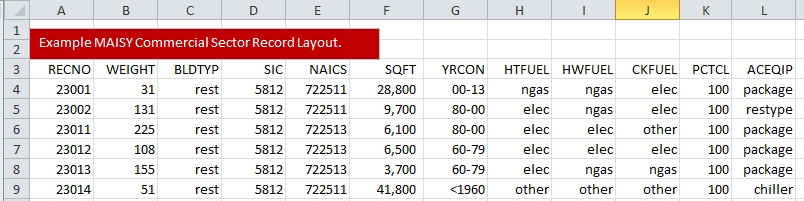
| List of Commercial Database Variables | |
Additional MAISY Residential and Commercial Database Background/Detail
|
||
Background/Detail TopicsData Sources and Reconciliation: MAISY databases are compiled from dozens of data sources including:
The Database Development Process Each database development includes four steps:
MAISY Database Accuracy/Comparison With Other Commercial and Residential Energy Consumption Data SourcesAccuracy: It is not possible to calculate MAISY multi-source statistical data accuracy with classical statistical approaches; however, our experience indicates that variables of primary interest to our clients are typically within a (+/- ) 10 percent confidence interval. These observations are based on applications for utilities where MAISY data have been evaluated against actual utility customers. MAISY databases are validated against a variety of sources including utility energy use and load data, load research data, FERC and EIA filings and more.Comparison With Other Energy Use and Hourly Loads Data Sources: The only other US data sources drawing on individual utility customer data and encompassing the entire country is the Department of Energy EIA's RECS (Residential Energy Consumption Survey) and CBECS (Commercial Buildings Energy Consumption Survey) surveys. While CBECS data are useful for some national and regional analysis, small sample sizes, large standard errors, lack of sub-region geographic detail, errors in modeled end-use energy use data, dated information, and limited coverage provide a questionable basis for using these data sources for most market and sales analysis, product development and design and other applications. For example, While the Department of Energy’s CBECS survey documentation reports 95% confidence intervals of +/- 8 percent for total US commercial buildings electricity consumption for its 2003 survey; drilling down to individual buildings (e.g., office, retail, etc.) yields 95% confidence intervals greater than +/- 25 percent for half of the sixteen building types. Drilling down to smaller geographic areas provides even less accuracy. For example, the 95% confidence interval for major fuels consumption in the West census region is +/- 67% for more than half the sixteen building types (e.g. food sales is +/ 84%). Applying these data means that, for example, food sales fuels consumption likely range is between 0.012 and 1.84 times the CBECS estimate. Drilling down for more detail results in even greater confidence ranges rendering results from these national surveys of limited use for geographic areas smaller than the nation as a whole. The most recent 2020 RECS (residential) survey (final release, June 2023) has an expanded sample of 18,400+ household records and provides state-level identification of each record. This sample size extension greatly expands the applicability and reliability compared to previous RECS surveys that collected data from approximately 5,000 households. However sample size limitations on drill-down analysis should still be recognized. A new MAISY Database product (MAISY RECS, introduced in February 2024, extends the RECS database to include household emissions and 8760 hourly whole building and end-use electricity kW loads. Click here to see additional detail on this new MAISY RECS Database. RECS Hourly Databases For applications that require greater segmentation or geographic detail below the state level, the 6.5 million household records and ZIP detail in the Standard MAISY Databases described above support these extended analyses. The Critical Issue of Sample Size in Drill Down Accuracy Drill-down accuracy of CBECS and RECS survey data is primaqrily a function of the number of sample records in the drill-down segment of interest. CBECS drill-down accuracy declines significantly with just a few drill-down as ~5,000 customer records is sliced and diced. While the 18,400+ record RECS survey sample is almost four times that of CBECS, state-specific samples range from about 300 to 1100 records so state-level drill-down accuracy may also be limited more than realized for state-level analysis. MAISY Databases provide significantly greater accuracy for drilldowns of more than several layers because of larger sample sizes and greater geographic detail. For example, a special extraction of residential customer records for a major manufacturer provided 50,000 statistically representative customer records for the Los Angeles metropolitan area and the same number for the San Francisco metropolitan area. By reconciling and integrating a variety of customer data sources, determining population characteristics, and applying a robust sample design, MAISY databases are able to deliver reliable detailed utility customer energy use and characteristics for small geographic areas and detailed customer segment specifications. MAISY data reconciliation recognizes and adjusts for weather differences, data collection strategies and sample designs, sampling error and other issues that arise in integrating multiple data sources. |
||
One OpenEI source provides commercial and residential engineering model-based hourly
8760 load results for various weather locations for a limited set of
commercial (16) and residential (3) building model input assumptions that typically do a poor job of
reflecting the population in any specific area
and cannot reflect the diversity of customers in market segments of
interest.
|
||
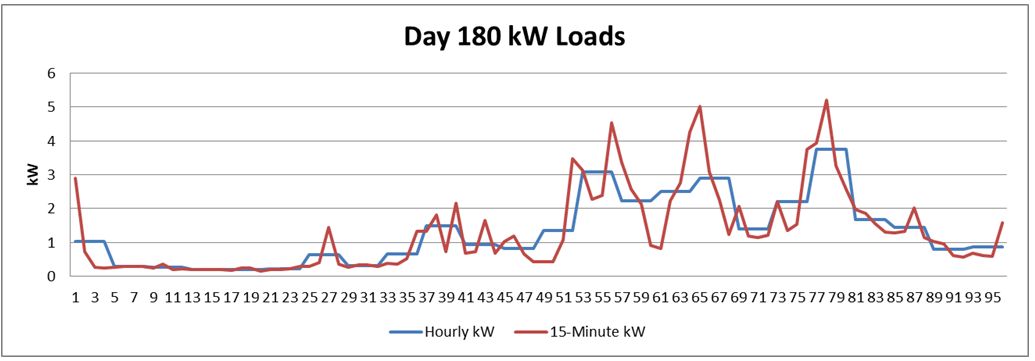
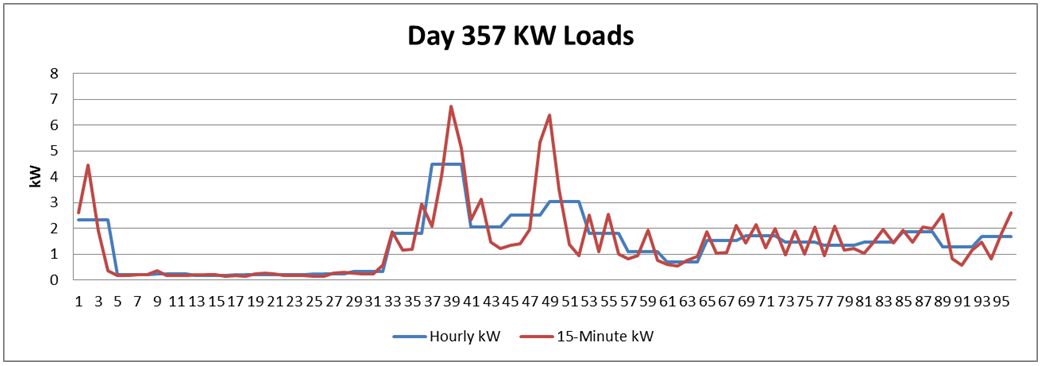
Hourly Loads DetailIn addition to annual and monthly energy use, equipment, building, operating characteristics and other customer information, MAISY Databases include hourly electric, loads for each customer record. Hourly kW load detail is based on actual metered electricity use data15-minute electric loads are also available and based on metered electricity use data. As one would expect, 15-minute data shows considerably more variation than hourly data (15-minute loads reflect an average of kW demand over 15 minutes rather than over an hour). Relationships between 15-minute and hourly loads depend on a variety of factors including the presence of electric space heating, water heating, air conditioning as well as dwelling unit and household characteristics (e.g, number of household members). 15-minute/hourly relationships are illustrated below for two days for a California utility customer with annual electricity use of 10,083 kWh. kW load data are provided for each of the 96 15-minute intervals in the day. The blue lines reflect the hourly kW for each of the 4 15-minute time intervals within each hour. The red lines reflect the 96 15-minute kW loads in the day.
Load data are weather-adjusted to reflect normal hourly weather data. Users can access and evaluate hourly loads for individual customer records or for any grouping of customers defined by database variables (e.g., heating fuel, business type, square feet, number of children, etc.) The large number of customers in the databases and the database design permits users to develop hourly load information for detailed customer types and market segments based on relevant customer characteristics.
|
||
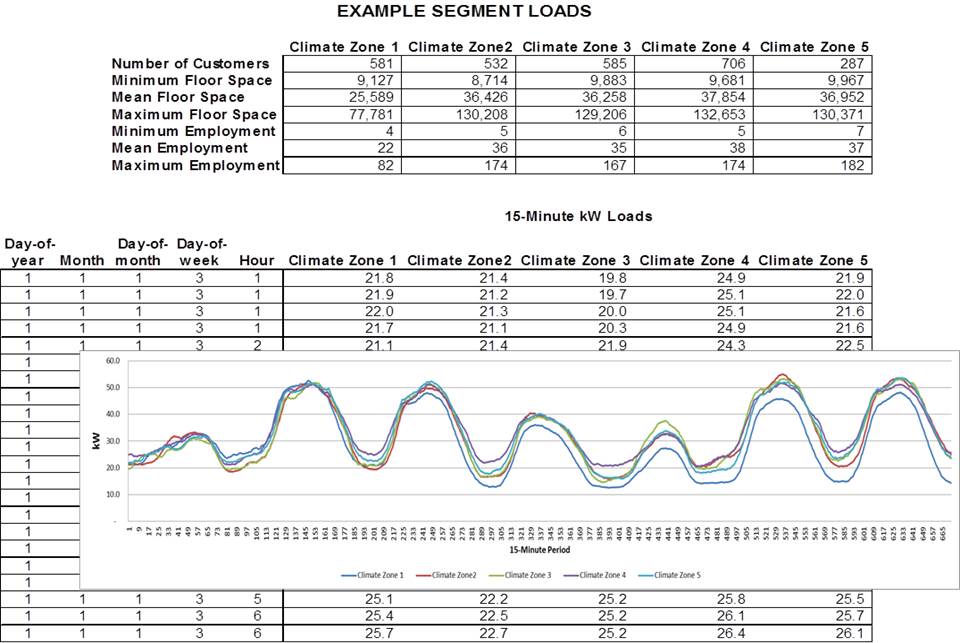
MAISY Excel WorkbooksDrilling Down in MAISY DatabasesMAISY databases have been developed with over 7 million utility customer records specifically to support energy use and energy-related analysis of user-specified, detailed customer segments (e.g., households in Dallas, single family dwelling units with incomes less than $25,000, small office buildings with electric space heating built before 1980, and so on). This deep drill-down capability is provided by a database sample design that reflects knowledge of our clients' applications.For example, if the population of customers includes a 10 percent electric space heating saturation, a random sample of 2000 would provide only about 200 electric space heating customers. However, with 20 commercial building types, the confidence interval around building-information would be quite high especially when one drills down to evaluate electric-heated buildings in different size categories. We know that electric space heating customers are of interest to our clients' applications so we boost the number of electric space heating customers pulled from the master MAISY database to ensure that users can conduct multiple drill downs on electric space heating customers with confidence. We apply the same criteria with other important customer variables. MAISY database record weights automatically adjust for this oversampling so that total customers, energy use and other customer segment characteristics always correctly reflect population values. Customer Segment DatabasesMAISY Utility Customer Databases can be provided for customer segments of interest. For example, a market analysis focused on the San Francisco market could include customer information on single family owner-occupied homes for customers with incomes of $100,000 or more and annual kwh use of more than 10,000 kWh. Master databases consisting of more than 7 million US utility customers provide more than enough detail to drill down to any client-specified customer segment. Individual utility customer records are extracted, processed and utility customer information is processed to reflect customers within each client-desired customer segment.Customer segment database information supports new technology product development and market assessment, marketing and sales market sizing and evaluations, and other applications that utilize information on markets and market segments. In addition to electric load data, additional information is provided for each segment including number of customers and average or typical characteristics of customers in each segment. The table below illustrates typical detail associated with both Commercial and Residential Databases. Segment definitions (e.g., ranges of floor space, peak kW, annual kWh, household income, geographic areas, etc.) are determined in collaboration with JA clients to meet technology development and/or marketing needs. Example Questions That Can Be Answered With MAISY Data:
Deciding on Segment Versus Individual Customer Databases  Segment versus Customer Data -
How to determine the best customer information development strategy
Segment versus Customer Data -
How to determine the best customer information development strategy
MAISY Individual Customer Data Versus "Prototype or Typical" DataThe MAISY system permits users to select individual customers or customer segments based on dozens of customer characteristics. Pick any combination of business type, floor space, operating schedules, space heating fuel, year of construction and many other variables to zero in on a specific customer type or market segment.What about other load-profiling systems that offer 12, 36 , 75 or some other limited number of fixed customer segments? To represent 13 commercial business types; electric, gas and oil heat; small, medium and large buildings requires 117 prototypes or "typical" buildings. Add in age categories and more than 200 "fixed prototypes" would be required, well beyond the scope of these "fixed" systems. With MAISY, customer and segment selections provide hundreds of possible definitions with nearly unlimited choices of customer characteristics. Only MAISY provides the detail and flexibility required to reflect the extensive, accurate customer and segment detail required in today's energy markets. Relying on "prototype and typical" is similar to analyzing a "typical" family which consists of two adults and 0.6 children - it may reflect an average but it may also provide misleading results when used to understand customers and markets, to develop programs to fit the needs of individual customer segments, to evaluate the profitability of serving these customers or to evaluate markets for new technologies. Sources of load profile data which rely on fixed customer segments (e.g. large, medium and small offices) typically develop hourly load data with engineering models (e.g., DOE2, OpenEI, NREL) of a single "prototype" building. The aggregate nature of these representations misses the variation that exists among individual buildings within these segments, hiding important market information. For instance, a particular electric rate structure may provide a competitive profit based on an entire segment's single prototype load profile; however, analysis of subsets of the segment (which can be performed with MAISY but not with the "prototype or typical" load profile approach) may reveal significant diversity in profit levels across customer sub-segments such that some customers are provided power at a loss while profit margins on other customers result in cream-skimming targets for other suppliers. Similarly, evaluating markets for new technologies or potentials for energy efficiency initiatives requires consideration of the full range of customers within a market or utility service area. The average load profile may reflect little potential hiding the fact that a significant portion of the market with different load characteristics provides great potential. For more information on this topic see Avoiding "Prototype" and Average Load Data Aggregation Errors . Other MAISY Database Products
ZIP Area Utility Customer Databases - ZIP-level averages
Household and Commercial Weather Risk Analysis - Risk assessments
|