The Surprising Economics of Data Centers, EVs, and Residential DR
Don’t look to residential DR to limit data center price impacts – instead focus on EV managed charging to lower residential electric rates
|
Jerry Jackson, Ph.D.
President, Jackson Associates June 25, 2026 |
|||||||||||||||
|
One of the greatest concerns about data center growth is the impact on residential electricity prices. Several widely cited studies suggest that demand-side flexibility resources could offset a significant portion of projected data center load growth. For example, a U.S. DOE analysis estimates that approximately 10 GW of an expected 50 GW of data center peak demand by 2030 could be offset through demand-side flexibility measures. A recent ACEEE study argues that expanded utility demand-side management programs, including residential load flexibility resources, could offset a substantial portion of projected data center load growth.
Another less-widely recognized threat to future electricity prices is increasing EV ownership. A residential Level 2 charger can add as much as approximately 11.5 kW of demand during peak periods - roughly four times the average residential peak demand. In addition to boosting electric demand at the most expensive time in the day, a neighborhood EV clusters can significantly increase grid maintenance and upgrade costs. This paper reports the results of a study designed to evaluate the potential for residential DR to limit the price impacts of both data center growth and EV adoption. The analysis produces two surprising results:
Residential DR Cannot Offset Data Center Peak LoadsThe study conducted a series of simulations across the US using observed data center and residential load profiles. Results showed that in every region of the country expanding residential DR can offset some data center peak power demand however the recovery period for AC and water heating programs will hit directly in the original residential peak demand period, potentially even increasing peak power demand costs.In other words, the timing mismatch in data center and residential peak load periods prevents a sharing of increased residential DR. Analysis results are summarized below. More analysis detail is available from the author. Table 1: Impact of Residential DR on Data Center and System Peak Demand 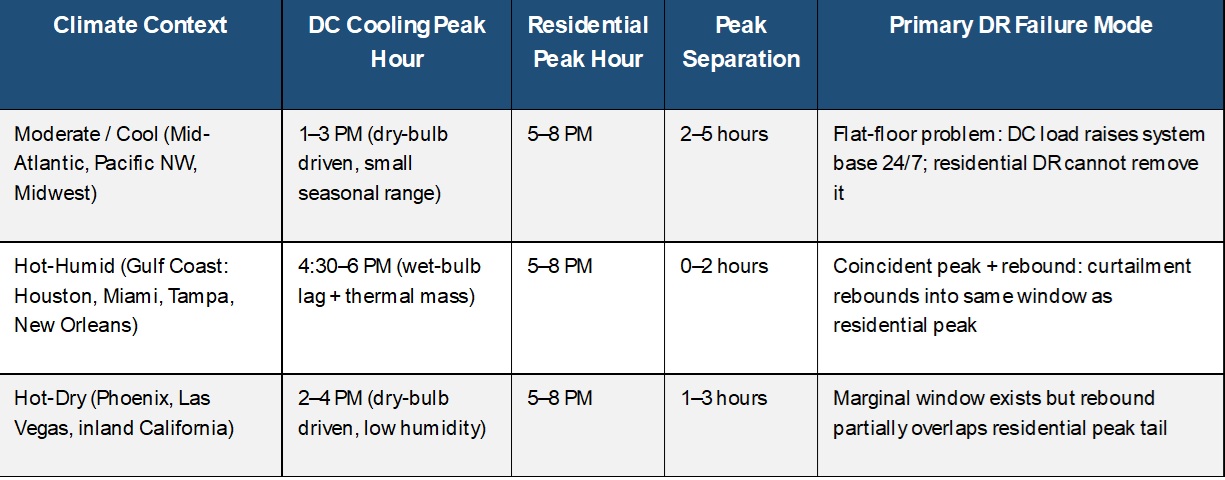
Of course, expanded residential DR can on its own reduce system peak; however, that is a topic for another time. Managed EV charging can potentially reduce residential electric ratesEVs currently account for approximately 8-9% of new vehicle sales. While average U.S. EV ownership remains near 3%, adoption is highly concentrated in many suburban and exurban communities, where EV penetration has already reached 10% or more.Using the MAISY® Utility Customer Database and Grid Impact Model, this paper evaluates the cost impacts of EV growth on electric cooperatives. Table 2 estimates annual G&T demand costs assuming EV ownership equal to 10% of residential customers and 75% coincident charging during system peak periods. Results show that unmanaged EV charging increases annual wholesale demand costs by $6.90 to $39.66 per residential customer, depending on G&T cost structure. Because these costs are recovered through retail rates, all residential customers share the resulting cost increases. Absent managed charging, cooperative costs rise in direct proportion to EV adoption. Table 2: Annual G&T Demand Cost of Unmanaged EV Charging per Residential Customer 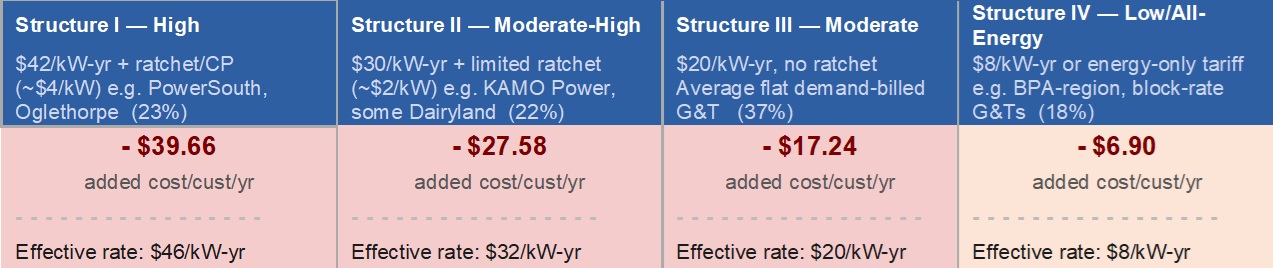
Next, we estimated the impacts of a managed charging program that shifts 90% of peak-period EV charging to off-peak hours. Table 3 presents the results on a residential customer per-year basis. The first row repeats the unmanaged EV charging costs from Table 2. The second row shows the remaining G&T demand charges after managed charging is implemented. The third row reports the incremental margin (new utility net revenue) associated with additional off-peak EV energy sales. Program costs are shown in row four, and row five summarizes the resulting net savings. Under all four G&T cost structures evaluated, managed charging produces net savings that exceed program costs. If passed through to coop members, these savings would reduce annual residential electric costs by approximately $0.91 to $7.99 per customer. These are remarkable results: managing a new electric utility challenge could actually reduce customer electric bills. Table 3: Six Rows per G&T Structure 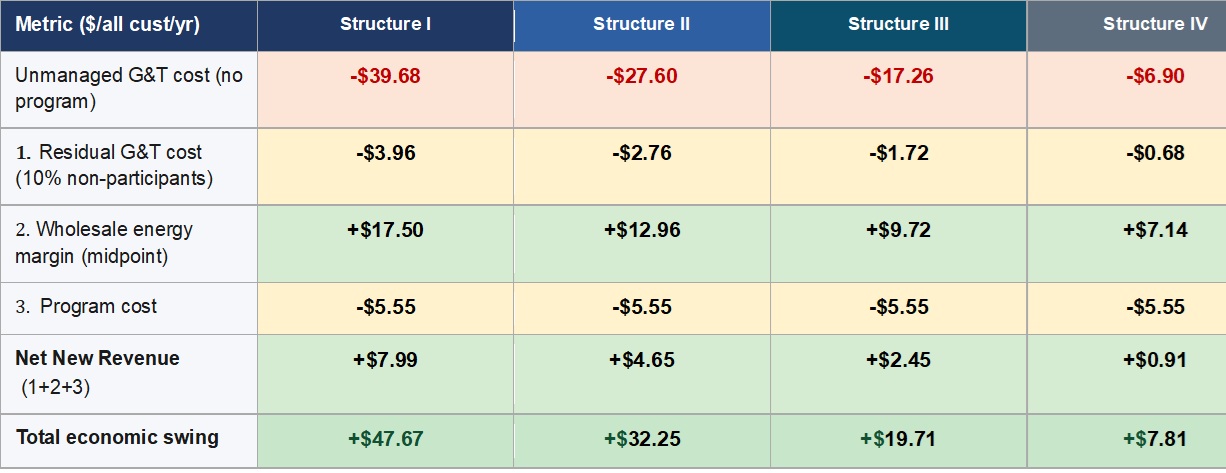
The analysis is based on conservative assumptions; actual savings for many cooperatives are likely to be larger than those shown in the table. Key assumptions are described in the Appendix. Two additional observations are worth noting:
SummaryThis study began with a simple question: Can residential demand response offset the electric rate impacts of data center growth and increasing EV ownership? The results suggest two surprising answers:
Appendix: Analysis AssumptionsEV Energy UseAnnual EV charging is assumed to be 2,880 kWh per vehicle, based on 12 kWh/day (approximately 37 miles/day at 3.1 miles/kWh) for 240 commuting days per year. The 37-mile assumption is based on FHWA average daily vehicle miles traveled. Use of the Department of Energy Alternative Fuels Data Center assumptions would increase annual charging energy by approximately 25%, making the analysis conservative. Wholesale Energy Margin Managed charging shifts EV load from peak to off-peak periods, creating a wholesale energy margin equal to the difference between the cooperative's off-peak wholesale energy cost and the retail rate paid by the customer. Because wholesale tariffs vary among G&Ts, the analysis uses representative midpoint values for four cost structures:
Program Cost Program costs are based on a cooperative serving 50,000 residential customers and are presented on a per-customer basis to facilitate scaling to other utility sizes. Total annual program cost is estimated at $5.55 per residential customer and consists of:
The analysis assumes 4,500 participating EVs (90% participation among 5,000 EV owners) receiving a $50 annual incentive. Customer incentives account for approximately 80% of total program costs. Without incentives, annual program costs would decline to approximately $1.05 per customer. Hardware —Incremental cost of the communication and control equipment needed to dispatch the managed chargers remotely. Assumes a Level 2 charger is already installed; cost includes — just the smart control module or software subscription that allows the cooperative to send an off-peak dispatch signal. Reflects either a low-cost smart plug adapter, a telematics subscription, or an over-the-air software enrollment fee for chargers that already have load control capability built in. Administration — Covers the incremental staff time and operational overhead of running the program — enrollment processing, event management, customer communications, help desk support. Customer incentives — $225,000/yr ($4.50/customer/yr). $50 per year bill credit paid to each of the 4,500 participating vehicles — a modest incentive designed to attract participation – in addition to off-peak charging likely save $100–$300 per year in energy costs. Customer Participation The analysis assumes 90% participation in managed charging. This represents a mature program rather than a first-year enrollment level. Utility managed charging programs typically achieve 40-65% participation initially and 70-80% as programs mature. The 90% assumption reflects the strong customer economics in the modeled scenario, including a $50 annual incentive and estimated off-peak charging savings of $100-$300 per vehicle per year. Together, these benefits provide participating EV owners with an estimated annual value of $150-$350 while requiring little or no change in charging convenience. Results scale approximately with participation. At 70% participation, G&T demand savings, energy margins, and program costs would each decline by roughly 22%, although the overall conclusion that managed charging produces positive net benefits across all four G&T cost structures remains unchanged. Related Grid Impact Model and MAISY Resources
Q&A: Data Centers, EVs, Demand Response, and Utility RatesCan residential demand response offset data center load growth?Residential demand response can reduce residential load during event hours, but this analysis finds that rebound timing can occur during the original residential peak period. That timing mismatch limits its ability to reduce data center-driven system peak cost impacts. Why can managed EV charging reduce residential electric rates? Managed EV charging shifts charging away from peak periods that drive G&T demand charges and toward off-peak hours where wholesale energy margins can be positive. When avoided demand charges and added off-peak energy margins exceed program costs, managed charging can produce net residential customer savings. Why are unmanaged EV charging costs shared by all residential customers? When unmanaged EV charging increases wholesale demand costs or triggers distribution upgrades, those costs are generally recovered through retail electric rates. As a result, costs created by peak-period EV charging can be spread across all residential customers, not only EV owners. How does the Grid Impact Model support this type of analysis? The Grid Impact Model applies MAISY customer-level hourly load data and customer digital twin methods to evaluate EV adoption, managed charging, DSM, VPP strategies, and localized distribution impacts at ZIP, block group, and service-area levels. About Jackson AssociatesJackson Associates publishes MAISY Residential Energy Use and Hourly Loads Databases consisting of 7+ million actual identity-protected utility customer records and the Grid Impact Model that forecasts localized, block-level EV, electrification, customer growth, weather and other distribution grid impacts and 8760 hourly load forecasts with a bottom-up customer digital twins model. |